
“It is not a political thing — it is a scientific fact that we are going through climate change.”
Carol Sparks, the Mayor of the small country town of Glen Innes, has recently described her experience of the ongoing NSW and QLD bushfires in her Guardian piece, ‘We’ve been in bushfire hell in Glen Innes – and the scientists knew it was coming’. Notably, she has no hesitation in exclaiming that the lack of action or contribution in mitigating the effects of climate change has directly resulted in a “a hotter, drier climate” that risks ever increasing damage as a result of fire and drought.
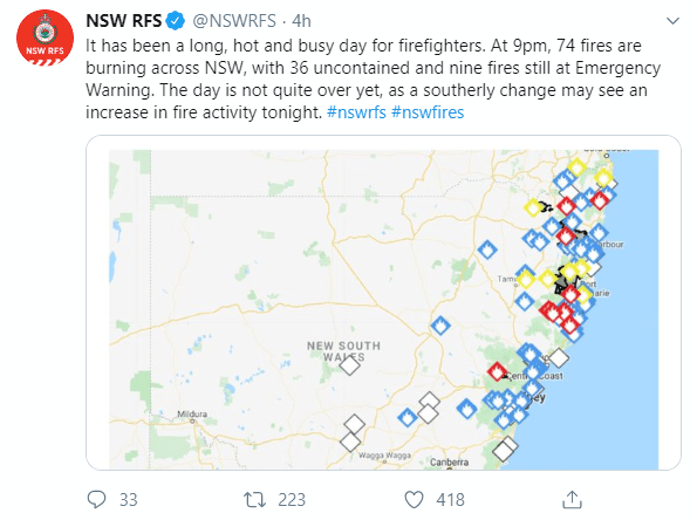
It is an entirely sensible and logical association to make; as hundreds of bushfires erupt around New South Wales, decimating over 1 million hectares across the state, The Bureau of Meteorology also reports that its forecasts that November 11th was the day that Australia receive almost no rain across the entire country were correct. Together with the CSIRO, the bureau also exclaim that “There has been an associated increase in the length of the fire weather season … Climate change, including increasing temperatures, is contributing to these changes.” When confronted with the topic, one Professor Bradstock states that “the research has all been done. We don’t need to keep doing it.”
Despite the overwhelming evidence accessible to everyone and anyone, the Prime Minister of Australia Scott Morrison, alongside a lamentable array of state premiers and business leaders, continue to downplay and disregard the very real crisis that lays before him. Earlier this month, Morrison gave an address indicating a “government crackdown against forms of activism and protests that the Coalition and the mining industry finds inconvenient.” Nationals leader Michael McCormack dismissed the link between climate change and the recent bushfires as the words of “inner-city raving lunatics”.
However inflammatory and repulsive these remarks may seem, it should come as no surprise from a government whose environmental policies include the introduction of native vegetation laws that make deforestation easier to the point where Australia has entered the 11 worst countries for deforestation alongside Indonesia and Brazil, and backed by a Prime Minister who exclaimed in parliament that “This is coal – don’t be afraid!” whilst clutching a lump in his hands. Just recently, Australia’s response, under the Liberal government, to the climate crisis has been deemed “among the worst in the G20” in a report by Brown to Green.
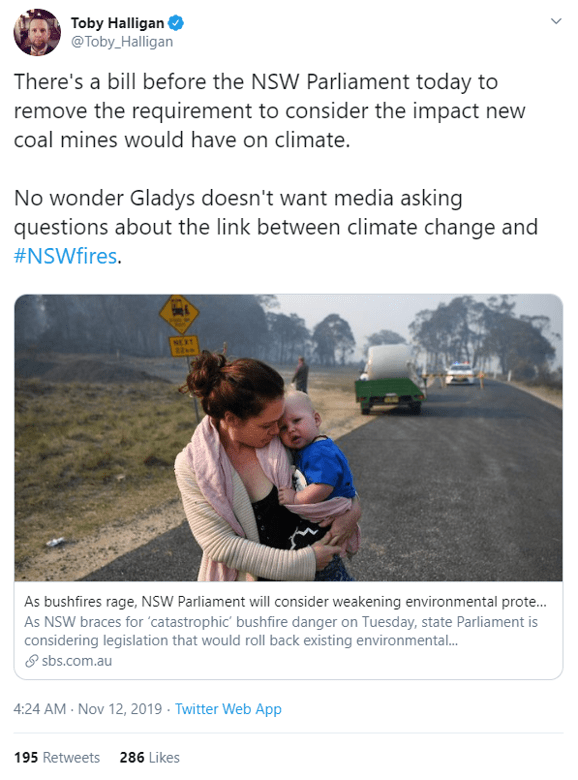
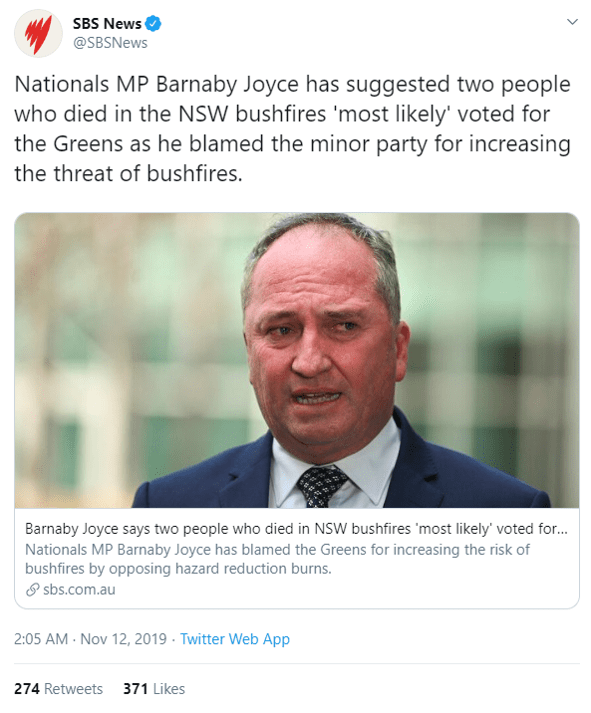
And that is not even taking into account the reprehensible responses to the NSW and QLD bushfires by members of this government. Barnaby Joyce, former Minister for Agriculture and Water Resources and leader of the National Party, has made a claim the that suns magnetic fields were linked to the bushfires, which has been widely rebuked. Joyce also made false claims in blaming the Green Party for a lack of “hazard reduction backburning”, and asserted that “two victims of the fires on the NSW north coast were probably Greens voters”. A number of sources also remind us of NSW Premier Gladys Berejiklian’s cuts to fire services, equalling $26.7 million.
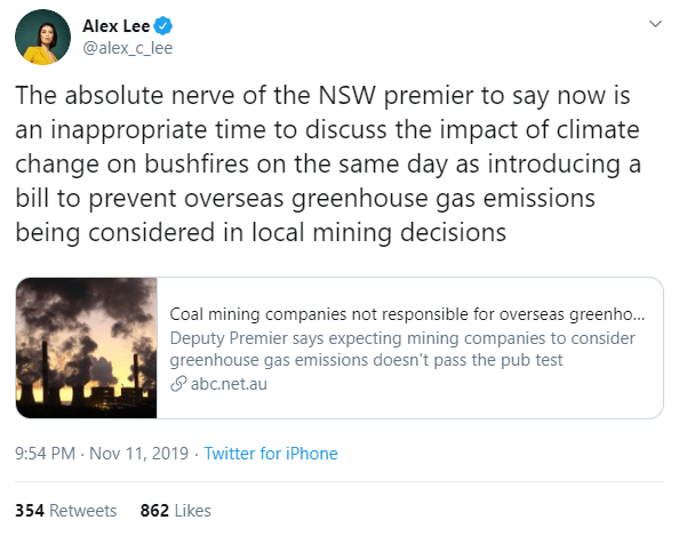
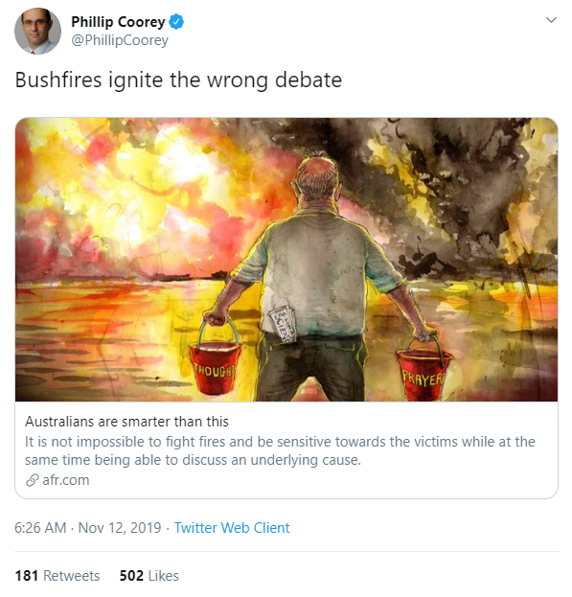
Finally, the willingness to disregard the evidence and conversation surrounding the link between climate change and bushfires (“Now is not the time to have that conversation”) further curtails the demand of measures to be implement by the government. Columnist Richard Denniss makes the comparison, “After each mass shooting in the United States, the gun lobby argues that it is inappropriate to talk about gun reform. And after the funerals, when it becomes “appropriate”, they then argue that it is irrelevant.”
Put simply, I applaud the leadership of Carol Sparks. Her words of encouragement and assurance for potential political direction of Australia should be heard and felt passionately: “…for the sake of the future, for the sake of our community and the rising generation who will inherit this scorched Earth, one can only hope there will be enough people remaining who retain the common decency to listen, to heed the cries of those in harm’s way, who will now together take decisive and collective action to save our ecosystem and our civilisation from collapse.”
 Declan Short